LBP Labeling

LBP
合作方:LBP Bingli Team
参与人员
Jiale GuYuan Chen
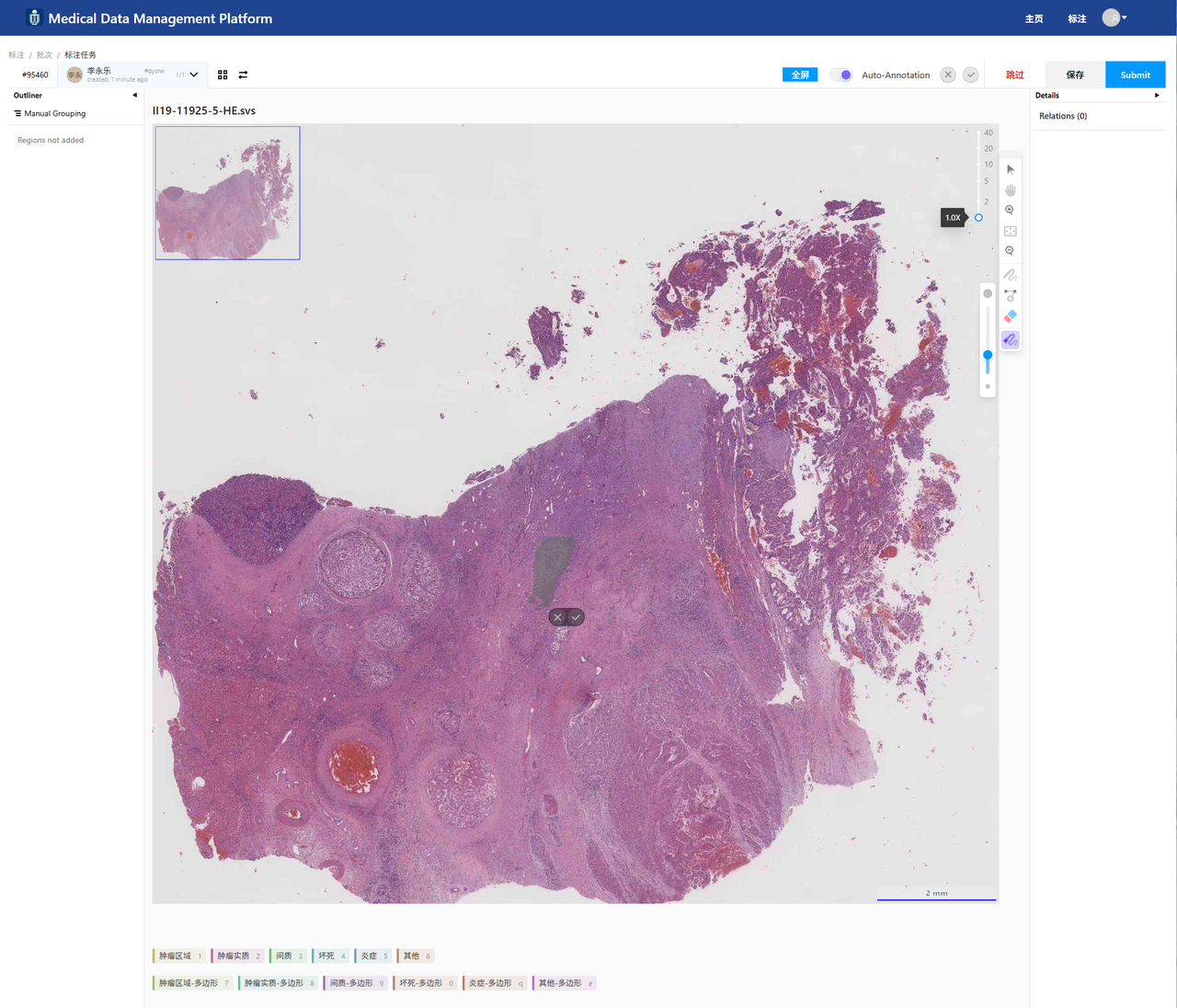
In the field of AI-assisted medical diagnosis, annotation serves as the core cornerstone for high-quality model training. However, the traditional manual annotation model has long been plagued by efficiency bottlenecks — especially when dealing with ultra-large-scale medical images such as WSI (Whole Slide Imaging), doctors are required to outline point by point and annotate frame by frame. This not only consumes significant time and effort but also tends to compromise accuracy due to fatigue.
To address this, the laboratory, in collaboration with LBP Group, has jointly developed and launched an intelligent annotation platform. Leveraging "AI empowerment + scenario adaptation", this platform breaks the limitations of traditional annotation and serves as an efficient annotation tool for doctors and researchers.
The platform’s core advantages focus on two key dimensions:
1. Comprehensive Coverage of Intelligent Tools for All Scenarios
It is equipped with basic annotation tools such as rectangles, polygons, and free curves, and further incorporates built-in functions including AI-assisted automatic pre-annotation, intelligent edge detection, and pixel-level segmentation. The platform seamlessly adapts to various medical images such as WSI, CT, and MRI — from pathological sections to imaging atlases — enabling full-scenario annotation needs to be met without switching tools.
2. Efficient and Accurate Annotation Experience
Taking WSI annotation as an example, the platform simplifies the process into four steps: "Upload - Pre-annotation - Fine-tuning - Export". After uploading an image, the AI, powered by a model trained on tens of millions of medical data samples, generates pre-annotation results within 10 seconds. Doctors do not need to start from scratch; they only need to fine-tune and confirm details. Compared with traditional manual annotation, this improves efficiency by over 80% while achieving a pre-annotation accuracy rate of over 95%, balancing speed and accuracy. It easily handles complex tasks such as tumor region annotation, lesion segmentation, and cell counting.
From freeing doctors from tedious manual work and shortening annotation cycles to providing a data foundation for medical AI innovation, the platform centers on "intelligence, efficiency, and accuracy" to redefine the medical annotation process. It helps accelerate the implementation of medical AI in clinical practice and better serve patients.